Why Sector 112 Is Attracting Developers
Discover why builders and investors are flocking to Sector 112. Connectivity, pricing trends, and growth data inside — updated for 2026.
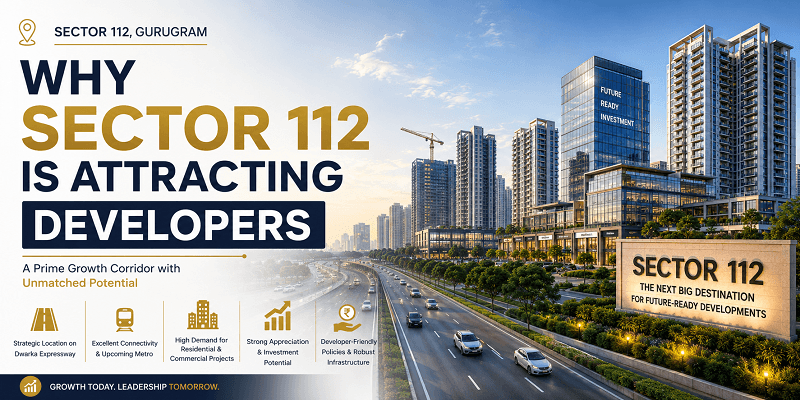
Why Sector 112 Is Attracting Developers
Discover why builders and investors are flocking to Sector 112. Connectivity, pricing trends, and growth data inside — updated for 2026.
By Real Estate Desk, Content & Market Insights Team · Published July 29, 2026 · Last Updated July 29, 2026 · 11 min read
Sector 112 has quietly become one of the most talked-about addresses on Gurugram's development map. Sitting directly on the Dwarka Expressway corridor, it offers builders a rare combination of available land, strong connectivity, and rising end-user demand — which is exactly why developer interest here has accelerated sharply over the past few years.
Key Takeaways
Sector 112 sits directly on the Dwarka Expressway, one of the fastest-growing infrastructure corridors in the National Capital Region.
Land parcels here are comparatively larger and more affordable than in older, saturated Gurugram sectors, improving developer margins.
Government-backed infrastructure — including the expressway itself and planned civic amenities — has de-risked long-term investment.
Growing end-user demand for property in Sector 112 is giving developers confidence in faster sales cycles.
The sector is part of a broader wave of Dwarka Expressway new projects, creating a self-reinforcing cycle of demand and development.
What Is Sector 112?
Sector 112 is a rapidly developing residential and mixed-use sector in Gurugram, positioned along the Dwarka Expressway between Delhi and central Gurugram. It falls within the Gurugram Master Plan's newer development zones, designed to absorb the city's next phase of housing and commercial growth. Unlike older, densely built sectors, Sector 112 still has significant undeveloped and under-construction land, making it especially attractive to builders looking for scale.
The sector's proximity to both Delhi and Gurugram's established business hubs gives it a dual advantage: lower entry costs typical of an emerging locality, combined with accessibility usually reserved for premium, fully-developed areas.
1. Prime Location Along a High-Growth Corridor
Location is the single biggest reason developers are betting on Sector 112.
Direct Dwarka Expressway frontage: Projects here benefit from direct or near-direct access to the 8-lane expressway, cutting travel time to Delhi and IGI Airport significantly.
Equidistant from two major economic zones: Sector 112 sits within reasonable reach of both Delhi's Dwarka sub-city and Gurugram's Cyber City–Udyog Vihar business belt, widening the potential buyer and tenant pool.
Reduced dependency on NH-8 congestion: Because the expressway diverts traffic away from the older Delhi-Gurugram highway, residents and commuters in Sector 112 avoid much of the bottlenecking that affects older sectors.
For developers, this means a shorter sales cycle — buyers no longer need convincing that the location works; the expressway does that job for them.
2. Land Availability and Development Economics
Older, established Gurugram sectors have largely run out of large contiguous land parcels, forcing builders into smaller infill projects with tighter margins. Sector 112 offers a different picture.
Factor
Land parcel size
Acquisition cost
Approval timelines
Scope for master-planned townships
Developer margins
Older Established Sectors
Small, fragmented
High
Often complex (legacy layouts)
Limited
Compressed
Sector 112
Larger, contiguous
Moderate
Streamlined under newer master plan norms
High
Comparatively healthier.
This combination of lower acquisition cost and larger land banks allows developers to plan integrated townships — complete with retail, green spaces, and community infrastructure — rather than standalone towers squeezed into existing layouts.
3. Strong and Growing End-User Demand
Developer confidence ultimately follows buyer confidence, and demand for property in Sector 112 has been climbing steadily.
Migration from central Delhi and older Gurugram: Professionals working in Cyber City, Udyog Vihar, and Dwarka are increasingly looking for newer housing stock with better infrastructure, and Sector 112 fits that need.
First-time homebuyer appeal: Comparatively lower entry prices versus fully-developed Golf Course Road or MG Road areas make Sector 112 attractive to young professionals and first-time buyers.
Investor interest: With property values in early-stage expressway sectors historically appreciating faster than mature markets, investors have added meaningful volume to demand.
According to market tracking reports on Dwarka Expressway micro-markets, sectors with direct expressway access have recorded some of the strongest year-on-year appreciation in the wider Gurugram region — a trend developers actively cite when planning new launches.
4. Government Infrastructure Push
No developer commits significant capital without confidence in supporting infrastructure, and Sector 112 benefits from sustained government investment.
Dwarka Expressway completion: The full operationalization of the expressway has been the single biggest catalyst, transforming what was once a peripheral zone into a well-connected corridor.
Road and utility development: Wider roads, planned sewage and water systems, and organized zoning reduce the civic risk that typically discourages large-scale development.
Proximity to upcoming metro and transit expansion: As Gurugram's public transport network extends further along the expressway belt, accessibility — and therefore land value — is expected to keep improving.
Airport connectivity: Being close to IGI Airport is a long-term structural advantage that doesn't erode over time, unlike short-term price cycles.
This infrastructure backbone is a major reason Dwarka Expressway new projects have multiplied in this belt over recent years, with Sector 112 emerging as one of the more active pockets within that broader trend.
5. Competitive Positioning Versus Neighboring Sectors
Developers don't evaluate a sector in isolation — they compare it against neighboring options before committing capital.
Feature
Connectivity to Delhi
Price per sq. ft.
Land availability for large projects
Social infrastructure maturity
Long-term appreciation potential
Sector 112
Excellent (direct expressway)
Comparatively lower
High
Developing
High (early-stage growth)
Nearby Established Sector
Good
Higher
Low
Established
Moderate (already priced in)
Best Suited For
Daily Delhi commuters
Value-conscious buyers, investors
Developers planning townships
Buyers prioritizing immediate amenities
Long-horizon investors.
This positioning allows developers to price competitively while still offering buyers a meaningfully better connectivity proposition than several higher-priced neighboring sectors.
6. How Developers Are Approaching Sector 112: A Step-by-Step View
Builders entering this micro-market tend to follow a fairly consistent playbook:
Land due diligence and title verification — Given the sector's newer development status, builders prioritize clean-title parcels with clear conversion approvals.
Master plan alignment — Projects are designed to align with Gurugram's sectoral master plan, ensuring long-term compliance and easier approvals.
Phased launches — Rather than one large launch, many developers release inventory in phases, allowing them to price later phases higher as infrastructure and demand mature.
Amenity-led differentiation — With multiple projects competing for the same buyer pool, clubhouses, green spaces, and integrated retail have become key differentiators.
Early marketing around connectivity — Nearly every developer active here leads their sales narrative with the expressway advantage, since it remains the strongest, most universally understood selling point.
7. Risks and Considerations Developers Are Weighing
No growth corridor is without its challenges, and serious developers factor these in before committing:
Execution timelines: Large townships require multi-year execution, and any delay in surrounding civic infrastructure can affect handover schedules.
Competitive saturation: As more developers enter the same corridor, differentiation becomes harder and pricing power can soften.
Dependence on continued government investment: Much of the sector's appeal rests on infrastructure that is still maturing; any slowdown in public investment could affect the pace of appreciation.
Balanced against these risks, most active developers still view the location fundamentals as strong enough to justify continued investment.
Conclusion
Sector 112's rise as a developer hotspot comes down to a straightforward combination: unmatched Dwarka Expressway connectivity, larger and more affordable land parcels, and genuine end-user demand that supports faster sales cycles. As government infrastructure investment continues and the broader corridor matures, this sector is well positioned to remain one of Gurugram's most active development zones in the years ahead. For those tracking Sector 112 residential development, the current phase represents the early, high-growth stage of a much longer market cycle.
Why are developers specifically choosing Sector 112 over other Gurugram sectors?
Sector 112 offers larger, more affordable land parcels combined with direct Dwarka Expressway access — a combination that's increasingly rare in Gurugram's more built-out, established sectors.
Is Sector 112 close to the Dwarka Expressway?
Yes, Sector 112 sits directly along the Dwarka Expressway corridor, giving residents and businesses fast access to Delhi, IGI Airport, and Gurugram's key commercial hubs.
How does Sector 112 compare in pricing to established Gurugram sectors?
Property prices in Sector 112 are generally lower than in mature sectors along Golf Course Road or MG Road, making it attractive for both first-time buyers and investors seeking early-stage appreciation potential.
What kind of projects are developers building in Sector 112?
Most developers are focusing on master-planned residential townships with integrated amenities such as clubhouses, green spaces, and retail, taking advantage of the larger contiguous land parcels available in the sector.
Is Sector 112 a good long-term investment for buyers?
Given its expressway connectivity, ongoing infrastructure development, and comparatively lower entry price point, many analysts consider Sector 112 to have strong long-term appreciation potential, though as with any investment, timelines and returns are not guaranteed.
How does Sector 112 fit into the broader Dwarka Expressway growth story?
Sector 112 is one of several active pockets within the wider wave of Dwarka Expressway new projects, benefiting from the same infrastructure catalyst that has driven development across the corridor.
What civic infrastructure is available in Sector 112 right now?
The sector has benefited from expressway completion, improved road networks, and planned utility systems, though some social infrastructure like large-scale retail and healthcare facilities is still developing alongside residential projects.
What risks should developers and buyers be aware of in Sector 112?
Key considerations include execution timelines for large township projects, increasing competition among developers in the same corridor, and continued dependence on planned government infrastructure investment to sustain growth.